Asheville is a small and beautiful town on the base of Smokies and every time I go there I am tempted by the music, the alcohol and the atmosphere of this wonderful place called Jack of the Wood.
I am delighted to have discovered this place... it is always vibrant with the music and the hustle & bustle of a lively pub. Sometimes its difficult to find a table so it might be wise to make a reservation especially on one of their live music performance night. They have some excellent ales brewed locally at the Green Man Brewery. So if you would like to spend an amazing evening at Asheville chatting with friends, enjoying live music and sipping some cold beer then don't miss out on the Jack while you are there.
Sunday, April 4, 2010
Jack of the Wood
Sunday, October 25, 2009
Shakshouka
When I was in New York... I frequented a small restaurant - Hummus Place. Its a small restaurant in Greenwich Village serving Mediterranean Cuisine. They have simple and well made vegetarian dishes which feel healthy and light. I was at this place with a bunch of friends and we were ordering everything in the menu... falafel, salad, stuffed grape leaves, different preparations of hummus etc etc...I came across this very interesting dish on their menu - Shakshuka. The description was simply eggs on Mediterranean tomato stew... and I thought it would be a dish quite similar to the North Indian Egg Curry. Well it arrived in a sizzling pan with a thick tomato sauce and eggs with sunny side up....and I was instantly hungry at the sight of it. Grabbed some warm pita and dived into it. It was spicy and tangy preparation of eggs and I just loved it. I had it a couple of times more at this place and later decided to prepare it at home. Here is my version of Shakshuka...hope you would like it :)
Thursday, August 27, 2009
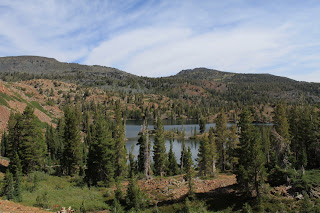
Camping - Lake Tahoe Desolation Wilderness
Map of the drive from Mountain View (A) to Glen Alpine Trail Head (C) through RangersStation (B)
View Lake Aloha Mt Tallac Trail Route in a larger map
Sunday, March 16, 2008
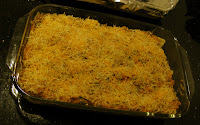
Italian Cooking - Lasagna Recipe
Now this one requires time and a little bit of expertise to make it, but once prepared you would realize that it is worth the effort. It is one of the best Italian dishes I have eaten, well probably because I ate the home cooked version. For people who don't know what Lasagna is - its another type of pasta. It comes in long flat strips, 3-4 cms wide and 12-15 cms long. Its prepared by making alternate layers of lasagna stripes, meat sauce and cheese one over the other. You prepare the sauce separately, boil lasagna and then make alternate layers. The outcome is layers of creamy, spicy, tangy and very tasty food. Well lets look at the recipe - its quite simple if you break it down into steps.
- 1 big chopped onion
- 1 big chopped green bell pepper
- 5-6 chopped green chilly
- 1 large table spoon chopped garlic
- 2 cup chopped spinach
- 800 gm of Pasta Sauce
- 400 gm Sour Cream
- 1 large table spoon of red chilly powder
- 2 tea spoons of Oregano
- 500 gm ground chicken
- 12 stripes of Lasagna
- Lots of Cheddar Cheese
- Vegetable Oil
Step 1 - Sauce Preparation
Start heating some oil (around 150 ml) in a large pan. When its slightly heated put 1 large table spoon of chopped garlic in it. After say 2 mins, add chopped onion and green chillies in the pan. When onions start to turn golden, add grounded chicken (keema), mix well and then cover it until the chicken gets cooked. Once the chicken is cooked add chopped green bell pepper and chopped spinach. Let it cook for sometime say 3-5 mins at medium heat then add salt, red chilly powder, Pasta Sauce (we used Francesco Rinaldi Chunky Garden Pasta Sauce) and oregano.
Step 2 - Boil Lasagna
Boil water in a big bowl and add 12 stripes of lasagna, we used Ronzoni, Healthy Harvest whole wheat, you can use anyone available in your market. Also add some vegetable oil to the boiling water so that stripes of lasagna don't stick to each other. Cover it and boil the lasagna until it gets cooked. Once its done drain out the excess water and take out the lasagna stripes. Its very important that you don't overcook the lasagna and make it soggy. The stripes should be intact and see that they don't stick to each other. Ok you are done with step 2.
Step 3 - Layering
Hmm...Get a large rectangular glass bowl and apply a thin layer of oil on the sides and the bottom on the inside of the bowl. Now start making layers of lasagna stripes, sauce and cheese. First put 3 lasagna stripes in the bowl then put a layer of sauce on it and then sprinkle cheese on top of it, then start with another layer of lasagna stripes. Do it with for all the 12 lasagna stripes, so that you will have four layers. Cover the top most layer of lasagna with a lot of sauce and cheese. Cover the glass bowl with the silver aluminum sheet.
Step 4 - Oven
Lasagna is supposed to be served hot, so when ever you want to serve it just put the glass bowl in the oven preheated at 350 degree Fahrenheit and then keep it there until the cheese melts. It will take around 10-15 minutes. Once its done, take out the dish and serve.
Sunday, March 2, 2008
Book Review: A Clockwork Orange by Anthony Burgess
Well well well well well... Nachinat...droogies this is one horrorshow book. Splattered all over with red red kruvvy and oozhassny acts like oobivating baboochka, sodding little devotchkas and tolchoking starry lewdies, with a smirk of radosty and a malenky bit of sarky soviet for society, o my brothers.
Thats Nadsat for you - the language of youth in Anthony Burgess's classic, A Clockwork Orange. It was first published in 1962 and since then it has become a cult book among the literary class. When I picked up the book and started reading it, I was only able to read 10-15 pages in few hours, that was because Burgess has invented a new language, Nadsat. Most of the words in Nadsat are derived from Russian and if you don't know Russian it will be very difficult for you to pick up the language. After reading the first 10-15 pages I knew that I needed a dictionary which has the entire vocabulary of Nadsat. I googled and found one on the internet - http://soomka.com/Nadsat.html. It turned out to be a very useful link and after that language was fluid and I finished the book in matter of hours. Its a very well written book and the language is so catchy and cool that after you finish the book, you can not stop yourself from speaking in Nadsat for a while.
The story revolves around Alex, who is also the humble narrator. He is the devil incarnate, he goes around with his gang of friends assaulting, raping and robbing people without any guilt and with all the joy, and thats his nature. He is a teenager who is wild and without direction or control. Society wants otherwise and they want to turn him into a good, mannered boy, but at what cost. Its an individual who has the right to choose between good or bad, its his conscience. It should not be imposed upon him, because doing so may take away his true character. And this true character and unrestrained will, differentiates human life. The writer has brought out this question very well and makes you think about it. The question is - individuals make society or society makes an individual.
The book is also sometimes compared to other dystopian novels like 1984 and brave new world. In my opinion, 1984 by George Orwell is a much deeper book. Orwell has created a much stronger story, his world is also hypothetical and nearly inhuman, but he has touched the subtle emotional aspects in a very humane manner, which I think is lacking in A Clockwork Orange.
A lot of credit for the publicity of the book should go to Stanley Kubrick's adaptation of the book in his 1972 movie by the same name. The movie hits you as much as the book. It is very well directed and visualized. But I guess the story is better told in the book and you can not concentrate on the language if you just watch the movie. Nadsat is the best part and you enjoy it much more while reading. So my brothers, first read the book and then see Alex come alive in Kubrick's - A Clockwork Orange.
Wednesday, February 13, 2008
Photography and Optics
Photography is all about capturing light. The entire essence is captured in the meaning of the word Photo-graphy which means "drawing with light". On the other hand Optics is the study of light and it tries to explain the optical phenomenon in a scientific manner. We all have done optics experiments when we were kids. I have spent many hours sitting out in the sun, playing with a convex lens trying to burn paper by concentrating the rays of sun on it. So you see such a simple experiment shows that light is just another form of energy which when concentrated can even burn paper. Photography involves a similar phenomenon, light waves are simply captured by a lens system and concentrated on a film (chemically treated) or a digital sensor, for a small period of time. This film or digital sensor produces the image as seen by the lens system of the camera. This is pretty much how our eyes function as well, in their case cornea is the lens and retina is the film/digital sensor.
So its all about light. Try answering these simple questions - what is light, how does it originates, how do you explain colors, why do different objects have different luster and texture. Proposing an hypothesis to explain the phenomenon of light must have been a challenging task. People have been amazed by what they see and some people get more excited if they are able to discern a pattern or fit it all into a model. There have been discussions to represent light as a wave (Hooke-Huygens-Young) or as a particle (Newton), later Maxwell studied light as an electro-magnetic wave and finally Einstein explained the optical phenomenon with the help of his Wave-Particle duality theory, which also laid the foundation for Special Theory of Relativity.
Light Meter - How do you know that you have the right exposure, that is you have the correct aperture and shutter speed settings. Light meter present on your camera is your guide. Light meter analyzes the scene and evaluates and measures the light offered by the scene. There are many evaluative methods that can be used by the camera like center-weighted, matrix-based etc. and based on these methods the light reading is obtained. You may use these readings as a reference while setting up your aperture or shutter speed.

Look at the lens diagram given above, image formation for a thin lens is governed by the following formula -
1/S1 + 1/S2 = 1/f
1/S1+1/S2 = 1/f
1/S2=0 i.e. S2 tends to infinity. So the image of the object will be formed at infinity and if S1 is less than f then image is formed on the same side as the object, which is the virtual image and it is no good to be captured by the digital sensor or the film. So if you want to photograph something really close to your camera, you need to have a lens with really small focal length i.e. for Macro Photography.
Film Size - Film size or the size of the digital sensor is actually the size of your canvas, where the image is drawn. Generally the film size is 35mm (diagonally). So the image we draw is also limited by the canvas size, which means that image magnification is important. This is where the Magnification formula comes into play -
Magnification = -S2/S1 = f/(S1-f)
Telephoto Lenses - We can see from the above equation that if you increase f and keep S1 constant, this is going to increase the magnification i.e. a bigger image of a distant object will be formed if you use a lens with larger focal length, these lenses are Telephoto Lenses, as they help you get a magnified image of a distant object.
Wide-angle Lenses - On the other hand if you decrease f and keep S1 constant, this is going to decrease the magnification, which you may feel is not exactly desirable. But consider an object in a scene near you, this object because its near has a good enough magnification, but it may happen that it is filling up all the space of your film canvas. So what do you do to get more of the scene on your canvas - you use a lens with a smaller focal length, this will make the object smaller on your film canvas and you can accommodate more of the scene. These lenses are Wide-angle lenses, as they help you get a wider picture.
Ultimately its Creativity!
I have spoken a lot about optics and photography, but the intention was not to confuse you or boggle you with nerd terms. I have tried to apply basic optics in order to understand how a camera works. These are just the basics, and there is a lot of creativity involved in using each aspect of your camera. As i said photography is drawing with light, so light and camera are just the tools which you can use for your drawing, but what you draw and how you draw depends on your vision and creativity.
The first step would be to understand what are the features provided by your camera and use them fully. It may be a basic digital camera, but you should definitely try to understand and use all its features. Once you start understanding it, you will see how much fun it is, and then you may even become oblivious of the optics behind your camera because your creativity will take over and i think that would be really cool :))
References
Here is a list of some good starter websites and books -
Understanding Exposure by Bryan Peterson - This will explain you the 3 key factors involved to get the correct exposure - Aperture, Shutter Speed and ISO. Excellent book to start with, it also has some brilliant pictures which will inspire you and push you deeper into photography. A must have book, don't wait to buy it if you are interested in taking good pictures.- photo.net- Excellent reference site for tutorials on photography, news and reviews about photography equipment, forums and discussions, pictures. Its a real good site.
- dpreview.com - Look here for in depth expert reviews on cameras and lenses. They cover their reviews in detail and it will definitely help you in making that choice.
- Wikipedia - I don't have to comment on wikipedia, but like for everything, it is also the ultimate source of information on optics, light, lenses, photography etc.
Thursday, December 27, 2007
Book Review: Kitchen Confidential by Anthony Bourdain
Have you seen the TV series - No Reservations. The guy who hosts that series is Anthony Bourdain. "No Reservations" is a travel show in which Bourdain moves around different cities/continents in search for an original culinary experience. What impresses me is that this guy is just not afraid. He is not prejudiced and is ready to try any food in the world given that it is adventures and authentic. You can see him killing a pig with a spear in Malaysia, consume a soup prepared from private parts of a mule in Indonesia, stand in icy cold water stream wearing just a thin robe in Japan, learning trapeze in New York City, getting twisted and turned all over in a traditional bathing house in Uzbekistan while savoring cuisines every where. Once he also got trapped in the middle east crisis while visiting Beirut, but they didn't stop and made an episode out of that as well. He has travelled across Europe, Russia, China, India, Malaysia, Vietnam, Korea, Japan, North America, South America and Africa. Anyone who respects good food will accept that it can come from any part of the world. Good food, if prepared properly will taste good and it happens only occasionally that you don't appreciate a well prepared meal. I guess that's the philosophy behind the show.

Saturday, December 15, 2007
Upside Down Pineapple Cake
Monday, October 8, 2007
Book Review: The Dragons of Eden by Carl Sagan

I just completed reading a book called The Dragons of Eden by an eminent scientific writer Carl Sagan. I picked up this book randomly from a book store. I have read Carl Sagan before, Cosmos - the book which opens up windows to scientific thinking, mathematics and of course astronomy, was very exciting and i would say my first scientific novel. I have also seen the movie Contact, which is based on a book by the same name, and its good.
So Dragons of Eden also promised a lot. Many times i have had discussions with my friends on topics like the difference between creativity and the clockwork attitude, comparison of artificial intelligence (computers) with human brain, evolution of human beings, what are dreams, why do we need to sleep, reproduction and many others. All these topics deal with biology and the way we perceive things around us. You can come up with so many different hypothesis to explain the above mentioned questions. What Carl Sagan does in this book is that he comes up with various scientific experiments that have been conducted and based on these he has discussed various hypothesis. These experiments seem to fit right in and corroborate these hypothesis.
The book is well written and is easy to understand. The reader can ignore the technical terms and look at the underlying logic or may be understand some terms from the appendix given at the end of the book.
This book was written some time around 1975 and i was amazed by the level of knowledge that Carl Sagan was able to extract at that time. A lot of new experiments have been conducted after 1975, but still the content of this book is very refreshing and by no means out dated. Carl Sagan prophecies that in future the level of understanding of human brain will be much greater and hence can provide answers to some ethical questions facing mankind like the definition of death, the legal issues of abortion, understanding of various cultures - including extra terrestrial life forms and animals. He also discusses computer gaming (imagine in 1975) and the way it can help spread an interest in science.
The price of the book in India is Rs. 250 and the book is published by The Ballantine Publishing Group.
Recommendation: Don't miss it if you have scientific bend of mind - it may answer a lot of questions.
Sunday, August 12, 2007
Cooking and Thermodynamics
Well the above law was cited to appear a little nerdy and later half of this blog will prove that when it comes to practicals my mother knows more about thermodynamics than me... and of course she cooks better.
Cooking is a great art but art is more subjective than objective. I say this because the complexities and factors involved in making tea or boiling an egg are far more than any thermodynamics experiment i have conducted. Don't ask me the complexity of making Mutton Rogan Josh. In this post i would like to give cooking a little objective look, so nerds like me can obtain the pleasure of live demostration of laws of thermodynamics and if they have any fears of cooking, they can extirpate them.
Cooking involves not just heating raw food, but also mixing of n number of substances like salt, water, meat, vegetables, spices, juices etc. Lets first take up heating and learn some basic thermodynamics. The outcome of zeroth law of thermodynamics can be that heat flows from a hotter to a cooler body, if they are brought in contact. This heat transfer will stop when temperatures of both bodies are in equilibrium. Heat Transfer can occur in 3 different ways - Conduction, Convection and Radiation. Out of these the most common way is Conduction, which involves two bodies (generally solid) coming in direct contact to transfer heat. Convection, which is made common by some Microwave ovens, involves transfer of heat through and with the help of fluids (air, liquid). Radiation, doesn't require any medium, this is the way used by Sun to heat up the earth.
Now let us look at the Fourier's law (nerdy for Law of Heat Conduction) which says that the rate of heat transfer through a body in contact with a heat source will depend on Heat Resistivity (good/bad conductor of heat), Surface Area of the body in contact with the heat source, temperature difference between the bodies and the thickness of the body.
So what does it mean in the cooking language -
- Heat Resistivity - Why does it take more time to cook mutton than to cook chicken, because the resistivity of mutton is less than that of chicken. A more direct example will be that of wood and metal. Metal has greater resistivity than wood. So wood will take much more time to heat up than metals. Next time you are cooking keep in mind the resistivity of your raw material.
- Surface Area in contact with Heat Source - The greater the area in contact the more the time it will take to transfer heat. So if you use a flat bottom utensil to heat, you know its going to take more time, but remember your food will be more evenly cooked. Thats why it is said that if you cut the meat/vegetable in proper shape, they will cook well. As the transfer of heat is even through them.
- Temperature Difference - Well this one is quite intuitive isn't it. But don't forget Newtons Law of Cooling (Newton seems to be everywhere from gravity to thermodynamics...i wonder if he was a good chef as well) - it says that the greater the temperature difference between two bodies the faster heat transfer will take place, so if the temperature difference was 30 degrees initially - Newton says that it is going to take lesser time to bring the temperature difference to 20 degrees than from 20 degrees to 10 degrees. It means if you took something out the refrigerator then it will not exactly take twice as much time to heat up...but it will take around 1.5 as much time or so.
- Thickness - Now when heat will exactly reach a point on your vegetable depends on how far is it from the heat source. The farther the distance the more time it is going to take.
Well as i said cooking is a great art and it involves not just heating but also mixing up so many other things, and doing them at the right time. The best way to train your mind to such a complex art it go out and explore and experiment. Science is good but taste is heavenly :)
Here is some Dilbert for you...trying to cook like an engineer :)